Carlos Eire's They Flew
A review

Last summer, I had the privilege of reviewing Carlos Eire’s book They Flew for Christianity Today. The book has evoked strong reactions, mainly praise but also some strong dismissals. To my surprise, my review even provoked a harsh comment from John Wilson in First Things, but his comments didn’t warrant a response.
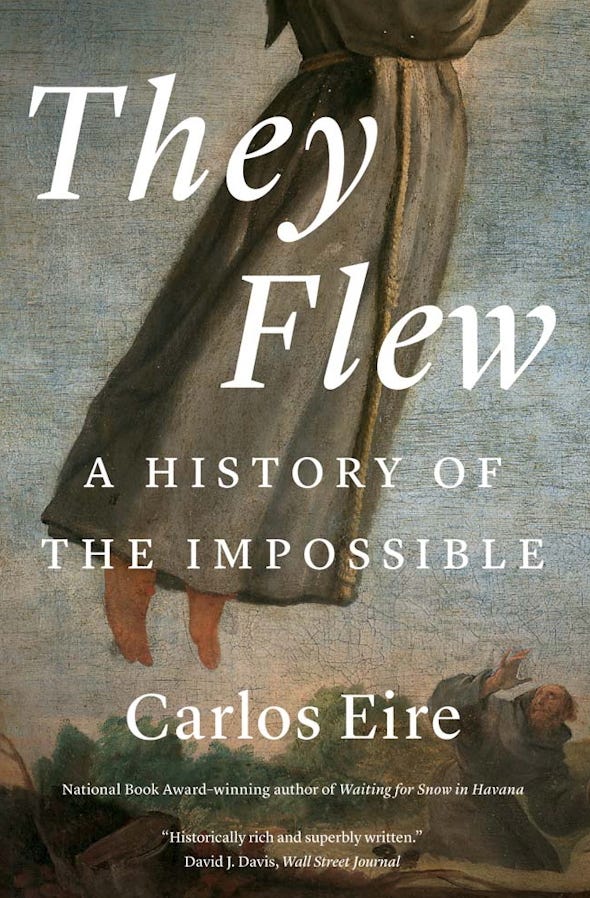
I was perhaps poised to be sympathetic to the argument because I had read not only Eire’s history of the early modern era Reformations (Yale) but also his biography of Teresa of Avila and A Short History of Eternity, which starts with a dizzying meditation on human mortality. I am also a fan of his outstanding memoir about his boyhood in Cuba, Waiting for Snow in Havana, which is one of my top 10 books of all time. So trust in the author, built up over years, allowed me to follow him into an admittedly strange and unlikely place (levitating and bilocating saints). One might say that there are some kinds of knowledge that require that kind of trust.
Or is that making things a bit too Kabbalistic? I am not entirely sure that Eire would mind. He did a whole podcast series on mysticism (which I found harder to enjoy, owing to its pacing and format).
While I wasn’t able to work it into the review, as I read the book I kept recurring to this famous passage from G. K. Chesterton’s Orthodoxy (1908):
Angels can fly because they can take themselves lightly. This has been always the instinct of Christendom, and especially the instinct of Christian art. Remember how Fra Angelico represented all his angels, not only as birds, but almost as butterflies. Remember how the most earnest mediaeval art was full of light and fluttering draperies, of quick and capering feet. It was the one thing that the modern Pre-raphaelites could not imitate in the real Pre-raphaelites. Burne-Jones could never recover the deep levity of the Middle Ages. In the old Christian pictures the sky over every figure is like a blue or gold parachute. Every figure seems ready to fly up and float about in the heavens. The tattered cloak of the beggar will bear him up like the rayed plumes of the angels. But the kings in their heavy gold and the proud in their robes of purple will all of their nature sink downwards, for pride cannot rise to levity or levitation. Pride is the downward drag of all things into an easy solemnity. One “settles down” into a sort of selfish seriousness; but one has to rise to a gay self-forgetfulness. A man “falls” into a brown study; he reaches up at a blue sky. Seriousness is not a virtue. It would be a heresy, but a much more sensible heresy, to say that seriousness is a vice. It is really a natural trend or lapse into taking one’s self gravely, because it is the easiest thing to do. It is much easier to write a good Times leading article than a good joke in Punch. For solemnity flows out of men naturally; but laughter is a leap. It is easy to be heavy: hard to be light. Satan fell by the force of gravity. (p. 125)
A passage worth reading twice. Surely St. Philip Neri would heartily agree.
Note: The title of the review was my editor’s, not mine. It’s not entirely inappropriate given what I wrote, but it’s a tad too focused on an effect of the book, which in some ways misses the point.
Without further ado, here’s the intro to my piece, which you can finish on CT’s website. Enjoy.
Catholic Miracle Stories Should Take Us Outside Our Protestant Comfort Zones
Even when they strain credulity, they can challenge our assumptions about popular piety and the limits of the possible.
July 11, 2024
On May 17, the Roman Catholic commission responsible for correcting errors in church teaching issued a guidance document with “Norms for Proceeding in the Discernment of Alleged Supernatural Phenomena.” While remaining open to genuine manifestations of the Holy Spirit, it addressed “serious critical issues that are detrimental to the faithful. … When considering such events, one should not overlook, for example, the possibility of doctrinal errors, an oversimplification of the Gospel message, or the spread of a sectarian mentality.”
The persistence of miracles within Catholicism distinguishes it from other Christian traditions. Belief in miracles represents not simply a concession to popular piety but a fundamentally different teaching about the work of the Holy Spirit and the response of the church.
Such things may seem baffling to most Protestants; in the commission’s words, they (and other doubters) would prefer to frame these phenomena as “believers being misled by an event that is attributed to a divine initiative but is merely the product of someone ’s imagination, desire for novelty, tendency to fabricate falsehoods (mythomania), or inclination toward lying.”
Rather than dismiss these claims outright, the Catholic church has established processes (like the May guidance) for adjudicating them. But this is just a refinement to a tradition of engaging with the supernatural that dates back centuries. And that history is the subject of a new book, Carlos Eire’s They Flew: A History of the Impossible.
Eire, a professor of history and religious studies at Yale University, examines how this process worked in the centuries following the Reformation. He focuses not on healings or apparitions, which are accepted more widely within Christendom, but on two extreme and peculiar supernatural events—levitation and bilocation (appearing in two places at once)—that reportedly touched the lives of several monastics and mystics.
As if that weren’t ambitious enough, They Flew sweeps into its narrative a host of related questions about competing accounts of the supernatural, their inversion in demonology and witchcraft, and their development alongside the Age of Reason. It asks readers to track with Catholic concepts of piety, holiness, monasticism, and bodily mortification, as well as the church’s institutional authority to define and regulate these matters.
Click here to continue reading . . .