

Summary: This episode of Humane Pursuits features economist Richard E. Wagner in a wide-ranging conversation on the meaning and trajectory of American federalism. Moving beyond textbook definitions, Wagner clarifies how federalism differs from mere decentralization and why the Founders believed a system of divided authority could safeguard liberty. The discussion revisits the often-overlooked Anti-Federalists, explores the Constitution’s deliberate ambiguities, and traces the gradual expansion of federal power through what Wagner describes as constitutional drift. Drawing on Vincent Ostrom’s idea of government as a “Faustian bargain,” the episode also considers how changing moral assumptions about the role of government have reshaped political and economic life. The result is a probing examination of whether federalism remains viable under modern conditions of scale, complexity, and shifting public expectations.
Note: The following transcript has been edited for clarity and length.
Garrett Brown: On today’s program, our focus is the foundational concept of federalism. We might already intuit something about the division of authority between the federal government and state governments, but how does it work in practice? And what does it look like in other countries? And is it rightly considered a liberty-preserving or -protecting institution? My guest today is here to help me sort through these questions.
Richard E. Wagner earned his PhD in economics from the University of Virginia and joined George Mason University in 1988, where he served as the Hobart R. Harris Professor of Economics. He is a leading figure in public choice and constitutional political economy, and his work has made significant contributions in public finance, federalism, and fiscal institutions.
He has authored more than 100 articles and numerous books, including Democracy in Deficit, Public Choice and Constitutional Economics, and The Fiscal Organization of American Federalism. I first worked with Professor Wagner on his book American Federalism: How Well Does It Support Liberty?, which Mercatus published in 2014 and serves as an excellent introduction to his distinctive approach to the topic.
Richard Wagner, welcome to Humane Pursuits.
Richard E. Wagner: Well, I’m certainly delighted to be talking with you about this topic.
What Is Federalism?
Brown: Excellent. At the outset, what is a general working definition of federalism that we can provide our readers?
Wagner: Federalism is a form of government where you have two independent levels of government in the same nation. And so, in a way, it’s very peculiar because it’s often said that federalism is a pro-liberty form of government. But don’t you have to ask, how can it be if people face two different jurisdictions that can tax and regulate them, how can federalism serve as a pro-liberty form of government, as compared with a system where they face only one government to tax and regulate them?
Federalism is often characterized as a pro-liberty form of government, as contrasted to a unitary, national form of government, in which there exists a sole source of political power. Yet one might reasonably ask how replacing a single government that can tax and regulate you with two or more governments that can do so would be favorable to your liberty. A simple question like this would seem to call for a simple answer. But indeed the correct answer is “it all depends.”
—Richard Wagner, American Federalism
Brown: It’s also important to distinguish between federalism and concepts such as decentralization or localism. How would you describe how it differs from those other modalities?
Wagner: Federalism means that the two distinct governments, typically a national government and a state government. Each have autonomy in that they can each choose the types of actions they want to take, the levels of taxation they want to impose. Whereas decentralization is a type of government where you have a national government that has branches. And so there can be a national government in DC, which has branches throughout the states, among the states, where each state branch receives orders and instructions from the national government. And that’s decentralization. The greater the amount that the national government sends off to the states, it would be called more decentralized, but there wouldn’t be autonomy in the sense that the individual states were not free to go their own way.
Brown: So they’re executing—the states in that arrangement—on the authority of the federal government.
Wagner: That’s exactly right.
Brown: It seems as if federalism is not only about a central entity and its subdivision. It also requires a constitution or an agreement, right? And it often is accompanied by other elements such as a two-part or bicameral legislature. What are the other features that usually accompany federalist arrangements to protect the sovereignty of both?
Wagner: Well, there’s a lot of differences in federalist arrangements, and many of those differences no longer, I think, are in play in modern societies. For instance, if you go back to the American Founding, there was an intense controversy over the replacement of the Articles of Confederation with the Constitution.
And we’re well familiar with the 85 Federalist essays, which were newspaper articles that were compiled in that period. But what we’re not so familiar with is that there were dozens of counter-essays to those Federalist essays that a fellow named Herbert Storing compiled in seven volumes titled The Complete Anti-Federalist, and he published a book that summarized all that under the title What the Anti-Federalists Were For (1981). And there’s a lot of contention that the Anti-Federalists were the true federalists compared to those who were supporting the Constitution.
Under the Articles of Confederation, there were 13 states, each of which was independent, and the basic theme of the Federalist essays is that 13 independent states could not maintain good civil order for two or three reasons. One is the possibility that the British or the French would invade again, and perhaps the Spanish. Individual states wouldn’t be sufficiently strong to forestall that. And another of the points that was made by the Federalist supporters of the Constitution is that you needed more authority by the central government to keep peace among the individual states because one of the things that was bound to happen and was already starting was a westward movement from the boundaries along that eastern seaboard. And in the contest for territory, there was bound to be conflicts, perhaps wars, among the states, and so you needed some way of keeping the peace with the westward expansion.
And so those were two of the main kinds of claims that there was something missing in the confederacy. You had 13 states, and that was all fine, founded on liberty and they all loved that, no question. But the problem was keeping away the French and British and keeping peace as the Americans drifted and moved west. And for that, you needed a different authority, the federal authority. Of course, the Anti-Federalists had answers to that challenge as well. They, on the one hand, doubted that the French or British would be able successfully to invade with the long supply lines they would have to maintain and that individual states could repel them. Likewise, it wasn’t impossible to keep internal peace with westward expansion.
The Anti-Federalists pointed out often that the way the federal government could support itself under the confederacy entailed their appealing to the individual states for funds to maintain federal programs. They said that quite often those federal programs did not return good value for their money. And if those programs were to offer good value for money, we would be happy to support them. And indeed, the states did support a good deal of the requisitions the federal government gave them, just not all of them. (I happen to think there’s a good point in all that, that the federal government does an awful lot, then as well as now. In Elon Musk’s search last year for fraud—it may not be called fraud, but there’s certainly a lot of tax money that goes into things that have no obvious return for their appropriation.)
And so at that stage, the Federalists end up winning, although it wasn’t an easy thing. It was like a two-year process from the first state’s ratifying it to the last state’s ratifying it, which I think shows that there was something in both sides that people valued.
The Faustian Bargain
Wagner: There’s more than just issues of the structure of government that is important for talking about federalism. I think there’s also a question to what you might call the moral sentiments or the moral sympathies of a population.
One of my favorite authors on federalism is Vincent Ostrom, now deceased. But he wrote an essay that brought up the term that government is a Faustian bargain, which means that government always involves the insertion of an instrument of evil into society in the hope that more good than evil will result, knowing that it may not always work that way.1
Now, that kind of moral sentiment, I think, was very much alive at the American Founding. If you read through the 85 Federalist essays and the many Anti-Federalist essays, they don’t disagree at all about government being what you might call a necessary evil to maintain civil peace. And there was a delicate balance that had to be maintained there.
Now, I’ve sometimes wondered if there were a poll taken today: “Do you agree or disagree with the statement, ‘Government is a necessary evil, a Faustian bargain?’” Well, one question would be: What share of the respondents would even know what you’re talking about by a Faustian bargain? And I don’t know what that answer would be. Beyond that, my own intuitions tell me that you might well get something like a 50–50 split in this country, where there are a good number of people who still believe that government is a necessary evil. We need it, it’s a very perilous instrument, and we have to be wary of it and have the right constitutional limitations on it. But there’s also a good number of people who would say, no, it’s not a necessary evil. Government is at the very forefront of creating good civil order, civic justice, etc.
At the time of American Founding, you might say if you used an image of a stage play, you have the actors on the stage who are putting on the drama. And then you have various stagehands who between the scenes change the scenery and keep it all flowing. I’d say politicians are the equivalent of the stagehands and the ordinary citizens are the people who execute the drama, where I think over the last century, or century and a half, during the Progressive era in particular, politicians have now drifted in and have become big participants in the drama as well — what I have often referred to as entangled political economy, the idea that politics increasingly gets involved in the commercial part of society, and commercial figures likewise are continually involved with politics in what is referred to as things like rent-seeking and so forth.
And so this is very much an ongoing concern about the place of freedom and liberalism in contemporary society compared to the late 18th century when the country began.
The Fifth Amendment illustrates sharply that the American Constitution sought to restrict majority rule, thereby expanding the scope for liberty. The Faustian bargain recognizes both that there might be good public purposes served by taking private property and that unrestrained legislative majorities would do this freely to secure price reductions for supporters of those confiscations, constricting liberty in the process. It is impossible to secure perfection in this situation. Simply to tell a legislative majority to take private property only when doing so serves a good public purpose will not do, because no legislative majority would ever assert that it is doing anything else. The ancient principle at work here is that people cannot be judges in their own cause, for those people will almost invariably see their causes as just. To promote liberty within a democratic system requires constitutional arrangements whereby legislative majorities can be overturned if they cannot secure concurrence from such differently constituted bodies as courts.
—Richard Wagner, American Federalism
Need for a Constitution
Brown: So the American Founding highlights an important point about federalism, and that is that a treaty is not sufficient. This is not simply an agreement between parties over a certain set of terms. It actually is the creation of a central entity, usually through a constitution. Is that correct? Because the Articles of Confederation was more or less a treaty, but it didn’t yield enough powers to the federal government to raise an army, to take on debt, to pay its bills. And so a constitution was needed for a stronger centralized government for a lot of those collective benefits that would accrue to all the states, not just individual ones. Is that correct?
Wagner: Yes, that is correct. So treaties by themselves are just, you might say, words on parchment. And to execute those words, you need some kind of structure of interest. I once wrote something called “Parchment, Guns, and Constitutional Order,” where you need both. You need an expression on parchment of what you aim to do, but you also need to have the right assembly of people with their various ideas and interests that are able to make that work. And that’s a whole different problem and a difficult one to boot.
Brown: One of the things that’s also highlighted in the American Founding is the fact of its sheer size. I was recently reading Dennis Rasmussen’s book, Fears of a Setting Sun, and he points out that the United States was the largest republic by far. And so that alone sets it apart from other experiments with federalist or even centralized government.
Rassmussen also points out that the Constitution was “deliberately but disconcertingly ambiguous on a number of key points, particularly with regard to federal-state relations and the separation of powers; its ratification did not so much settle the country’s political disputes as provide a new arena in which to fight them. There were few precedents or fixed poles to guide the nation’s lawmakers, administrators, and judges. . . .”
Wagner: Yes, again, the American Founding created a republic on a larger scale than what had been known with republics. But then when you look at it today, with an aggregate population of 350 million or so people, Switzerland today probably comes closer in scale than most modern nations to the early American republic.
Republican government had never before succeeded on a large scale. The only republican governments at the time were either small city-states like Venice and San Marino or confederations of city-states like the Netherlands and Switzerland. There had never been a republic the size of even the original thirteen states in all history. Ancient Greece had its democracies, and Rome had been a republic for a time, of course, but the founders generally saw these precedents less as models to follow than object lessons of what to avoid.
—Dennis Rassmussen, Fears of a Setting Sun
A lot of issues come up when the scale of government is small. So a lot of business gets done informally. So you can have a town that has a town council, a town of 10,000 people, a town council of five. Much of the business gets done informally, whether it be while waiting for a car to be repaired, going shopping and stuff like that, that gets ratified in the formal meetings.
But when you get to cities in the millions, that business doesn’t take place in the same fashion. It’s much more formalized. It’s also much more open to lobbying, law-growing, interest groups, and so forth. And I think the modern kinds of sizes, formalities, create whole new problems of government that I think work in the direction of saying that we are an over-governed society, I think comes out very clearly. And for anything that governments end up doing these days, I would submit that there are ways of getting the same things done outside the sphere of modern-day bureaucratic government.
Brown: How does federalism address or fail to address problems associated with large-scale governance?
Wagner: I don’t think it addresses it very well. Switzerland probably addresses those problems better than any government of which I’m aware, although I’m not aware of all forms of government in the world, by any means. But Switzerland, if you notice, goes by the name confederation. But Switzerland still has institutional mechanisms allowing cantons to resist or challenge national legislation.
Now, we had a cousin of that arrangement before we had the direct election of senators [established by the Seventeenth Amendment in 1913] because back in the day when senators were appointed by state legislators [as originally provided in Article I, Section 3 of the Constitution], what you had there was a kind of an arrangement where the Senate was a kind of a council of states [i.e., representing state governments as political units rather than individual voters] because the senators were responsible to the state legislatures for their appointment and their reappointment. After the direct election [of senators by popular vote], senators became responsible for their own constituencies they could create within their states that were going to elect them. And that created a very different kind of mix of interests on how you maintain your position as a senator when you were appointed by the state legislature, than when you were elected by voters within the state. And that plays out differently in federal politics relative to states, and in a way that made more of a nationalized system of government than it was before.
Brown: In a federal system, does the constitution always sort out what the federal government will take on differently from the state or the province or region? Is that always explicitly stated, and yet whatever’s reserved to the state may not be referred to in the constitution?
Wagner: Well, you referred earlier to ambiguity in the Constitution, and that it is. Again, constitutional parchment is not itself capable of governing. Governing can only be done by people. And people all come at their task with beliefs, interests, and attitudes. And, in that, one thing that’s important is how they get into those positions of being able to wield authority. And so federal systems are always going to be operated by people with positions they’re seeking to keep, to maintain, to expand. And it’s no different in federal systems than in unitary systems. That’s what I would call a universal fact of life.
It’s a kind of a category mistake, speaking of philosophy, to think that you write up a constitution, and the process stops there. For instance, our original Constitution limited the federal government to roughly 17 or 18 enumerated powers [according to Article I, Section 8], nothing else. Now, there is no constitutional amendment that says the federal government can do whatever it wants. No such amendment. And yet that’s the world we now inhabit. That it’s a matter of the conflict of interest among people that’s going to govern what the federal government does. It’s not a matter of some kind of constitutional delimitation of authority.
And that’s the real politics of the situation, the real politics of federal systems, the real politics of unitary systems. I would say the real politics is the same because that goes back to fundamental human nature and what we’re like. And when you’re talking about people in politics, just like successful people in commerce, they are self-selected from the most energetic, aspirational members of a society who work with ideas, ambitions. And they are the people who get into positions of political power, commercial responsibility. And that’s where the future is always going to be made.
I think our theories about governance and so forth have not done a sufficiently strong job of squaring the kind of what you might call the normative constitutional ideal with the reality of—there’s a temptation to say let’s just make a constitutional amendment to get rid of something we think is an undesirable practice.
James Burnham, in Machiavellians: The Defenders of Freedom (1943), tried to say that you have to take account of the interest of people in power in high-level political positions. And how constitutional provisions may work out is going to depend on what people in power are going to try to do. And how to limit that is a more complex matter that can be addressed but hasn’t been addressed very well to date.
In the compound republic of America, the power surrendered by the people is first divided between two distinct governments, and then the portion allotted to each subdivided among distinct and separate departments. Hence a double security arises to the rights of the people. The different governments will control each other, at the same time that each will be controlled by itself.
—James Madison, Federalist 51 (1788)
Brown: How could it be addressed?
Wagner: There’s a wonderful book by a prominent legal historian of a generation past titled Congress as Santa Claus (1932) by Charles Warren. And what he did was trace the history of the General Welfare Clause starting from about 1800 or so. And the first case he looked at was a drought in Ohio, and someone proposed giving aid to the farmers in Ohio. And then there’s a famous story — perhaps apocryphal — about Davy Crockett, before he moved to Texas, serving as a member of Congress from Tennessee, standing up and saying, “We don’t have any constitutional authority for this, even though I agree that this drought is a horrible situation for these farmers.” Supposedly, he then took his hat off, put some coinage in it, and passed it around to take up a collection to send to the farmers in Ohio. Because that was within the authority of Congress, whereas appropriating funds was not.
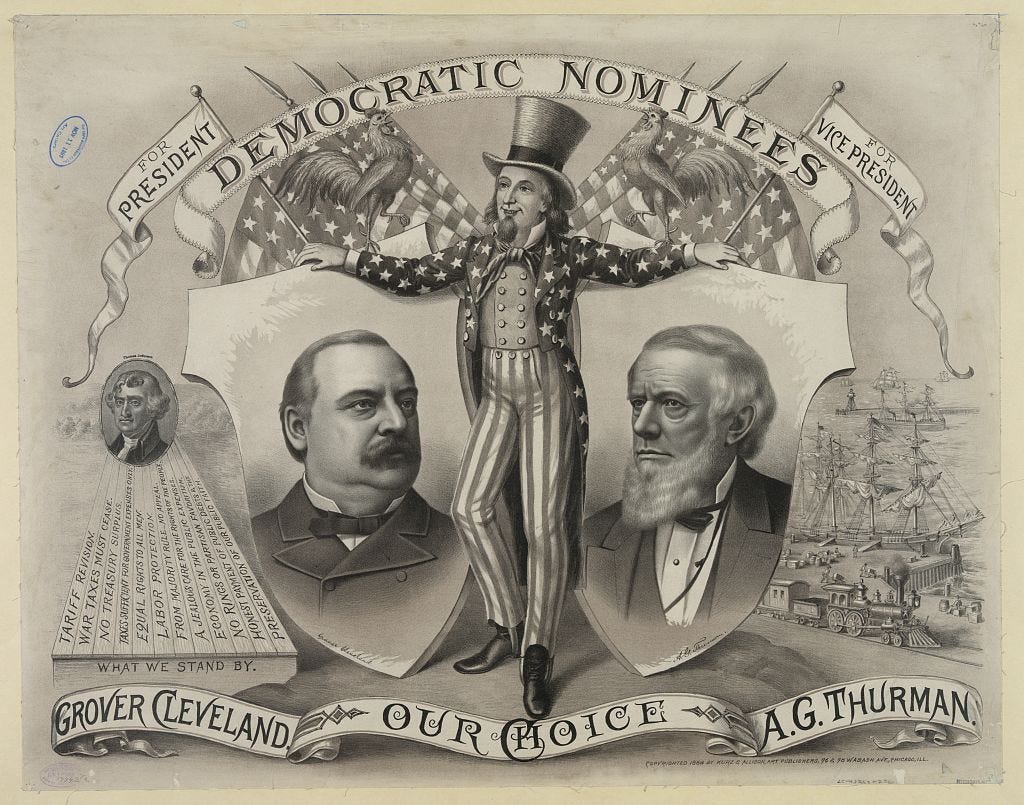
Appropriations, as clearly written in the Constitution, had to be for purposes of promoting the general welfare. And that wasn’t the general welfare. It was a specific welfare of some Ohio farmers. So Congress turned it down and sent their personal money to Ohio. Warren explained that that pattern was repeated again and again and again as the years went by, the margins by which the motion was rejected becoming ever narrower until around 1880 or so, it was accepted. This time it was a motion for aid in Texas, at which time Grover Cleveland vetoed it.2 And there were a few more presidential vetoes of the same appropriation until Franklin Roosevelt passed similar measures.
And so then what you had was initially a situation where there’s no rewritten constitution at all, but there was a situation where the Constitution and the general welfare clause served as a limitation on the ability of Congress to appropriate. The appropriation had to be for something that seemed to be of general interest throughout the nation, big parts of it. But, by the 1930s, the general welfare was whatever Congress said it was. So there was no more limitation on Congress because Congress determined the content of the general welfare through its appropriations.
Now that takes us back to these questions of moral authority, moral imagination, which I think are also important. We tend to think that if we get the right structure, people will do the right things. An alternative attitude on this is that what people will do depends on their values, their moral imaginations. Because when we’re talking about action, we’re talking about some vision you have of how you propel yourself from where you are sitting today into the future, because all action goes into the future.
This matters. The moral imagination that people harbor is important, as scholars like Martha Nussbaum have done a lot of work on in this respect. [See Poetic Justice: The Literary Imagination and Public Life (1995).] Gertrude Himmelfarb as well. [See The Moral Imagination: From Edmund Burke to Lionel Trilling (2006).] We’re talking about the moral imaginations of a population. That population at one time thought the idea of a Faustian bargain was a good way of summarizing calls of government to do something, to intervene in society.
That Faustian bargain is a particular imagination that, I would submit, does not withstand modern social kinds of power formations. Public schooling — I don’t think you’ll find Faustian bargains anywhere within the whole plethora of public-school institutions these days. I think where I’m at is that federalism is an important piece of governance and the structure of governments, but good governments also intimately depend upon the moral imagination of its citizens.
What is it that the people who inhabit a society want to accomplish with their lives? And how do they think about that? Then where do those presumptions that people harbor come from? Those are all important pieces of governance. We’ve gotten in our institutions and in our politics, many things far away from those concerns into a concern that all that matters now is equality, without any sense of what it is that people are accomplishing or trying to accomplish or seeking to accomplish or not seeking to accomplish.
Competition in a Federalist System
Brown: At this point in our conversation, seems as if we should return to a central question, which is how can we have a federalist system with two levels of authority support liberty rather than threaten it?
Wagner: Well, it’s easy to think of the ways in which a federal government could impose a pro-liberty agenda upon state governments. It’s not likely, in my opinion, that such an agenda would survive modern congressional politics. But it’s also easy to think of how a national government could impose agendas on state governments that would undermine. It goes both ways.
Brown: How does competition function within a federalist system to ensure liberty? And what does competition between states really mean?
Wagner: Competition, I don’t think, means a whole lot between states. Competition is, I think, just a different name for liberty. That is, if people are free to live where they choose, we give it that name competition. States might try openly to attract residents, but we know that’s not a general concept because many states are also trying to find ways of repelling residents, or at least if you look at these days California, New York, and so forth as repelling residents but trying to keep their wealth intact by taxing them. It’s astonishing to me that there’s very little active use of trying to attract more residents through policies of lower taxation. There’s certainly evidence that states with lower taxes turn out to be more attractive to people, indeed, but it’s not so much an active program.
It has often been noted that all politics is local politics. This simple observation conveys a deep truth about political competition and the difficulty, if not the impossibility, of maintaining independent action among political entities within a federal system.
—Richard Wagner, American Federalism
Brown: But in the sense of competition among the states, does this align with Supreme Court Justice Louis Brandeis calling them “laboratories of democracy”? Is that an essential aspect of federalism, or is it secondary?
Wagner: I think it’s probably secondary these days, but it’s a good notion. In a universe where politics was a rational activity, the ability of states to try different programs would be a source of evidence about the effectiveness of different programs. Now, back in the ’70s, maybe the ’60s, there was a time when this laboratory of the states was put into operation through testing of various kinds of welfare-like programs in welfare payments. I think it was in Denver. The outcome was that it was a fairly simple thing to design welfare programs that would discourage work, as it was to encourage work, but that there seemed to be no overwhelming force within those states to encourage rather than discourage work.3
Which again tells me that humans are difficult subjects when you talk about their governance. Again, it’s a Faustian bargain. Some people will recognize that.
How to Judge Federalist Systems
Brown: What criteria should be used to evaluate whether a federal system is functioning well?
Wagner: Well, about the only criteria we have that would find some kind of agreement would be the usual materialist criteria of average income, rates of growth, rates of employment, and those kinds of things. I’ve been a proponent of the fact that economics has overly embraced the material element of its discipline. And going back to Adam Smith and the classicals, there is much to be said about how different systems of government might feed into creating attitudes about themselves and the lives they’re living, realizing when you go to it that each of us is given a life by our parents, and the challenge for us is always what we’re going to make of it, what we’re going to do with it.
How do systems of government support leading energetic, fruitful, productive lives when, for instance, just on this high tax, low tax. On one hand, I would submit you have a tax system that aims mostly to tax success to subsidize failure or nonsuccess. Now, most people would object to that description, but I think it’s a reasonable description. And so you can think of how much of a public-support budget you have versus how much of a private-charity budget exists.
There is a wonderful book by David Beito on mutual aid societies versus the welfare state and how the welfare state came in, and while it didn’t abolish it, it largely led to the shrinking of mutual aid societies [From Mutual Aid to the Welfare State: Fraternal Societies and Social Services, 1890-1967 (University of North Carolina Press, 2000)]. But in mutual aid societies, people were still operating within the open-market system. Various charities would impose requirements on people they were supporting to seek jobs, keep themselves clean, and so forth.
When you move to public doles, that all disappears. And so that’s where you get more of a life of living on handouts. It’s a moral imagination that doesn’t see yourself as anything but simply existing in the state you are. And that’s a scheme of life that comes out of so much public support. And I think along those margins are some very significant, very important things that I think are acting as corrupt influences on modern-day life.
In 1900, governments in this country amounted to about 10 percent of total national activity. Now they account for a dramatically larger share of national activity — by some measures approaching half of the economy.4 Now think about that. What happens? And you go to the Founders’ world, governments were, again, about 10 percent, which means that the vast preponderance of the moral imaginations that people acquire — the ways in which they learn to conduct themselves, live with other people, and all that — are all fundamentally in a commercially oriented society.
Now, when the governments approach 50 percent, that means that you can’t escape government. Moreover, much of what goes on commercially is going to be influenced by governmental political activity. Even such things as the water temperature of your shower isn’t a matter of a producer trying to appeal to customers but is rather governed by a political operative working together with the producer, where the producer has to get the political operative’s permission to release a product. That, I think, affects manners in society, outlooks, how people comport themselves. . . .
That’s why I think, fundamentally, in these societies where 90 percent of the activity is organized through various private activities, people spread themselves throughout the society, reacting to other people. Now when governments — so it’s the political sphere that governs 50 or so percent, maybe even more, because whatever a government does through taxation and the budget, it can also do by regulation. So it becomes more difficult.
I think federalism today is a reasonable aspiration — and a lovely piece of history. One remembers Benjamin Franklin at the close of the Constitutional Convention walked out of the room, and a woman [Elizabeth Willing Powel] is reputed to have asked, what kind of government did you folks give us? To which he responded, “A republic, if you can keep it.” And I think the evidence is we haven’t kept it.
We have certain features of it, but the outlook, the moral imaginations, the attitudes have undergone the transformation. Now, a big question is whether that transformation has been inevitable, dictated by population growth, technological circumstances. Maybe Malthus was right about all these things.5 And so we’re living at a scale, a population, that the old ideas of republics, in which federalism is a form, is having a difficult time. It’s federalism being asked to thrive in an ecological environment in which it’s incapable of thriving because the scale of governments is just so overwhelming.
And so the scale of governments is going to create more of a class where some people are going to rise. You’re going to have Elon Musk sending spaceships out and so forth. There’s room for that. Then you’re also going to have people squatting in cities, homeless people, people lacking ambition, and so forth, maybe all part of the same structure. I hate to think of it that way, but that, I think, is a case to be thought of as well.
Further Reading
Brown: As we conclude our time together, where would you direct readers if they wanted to learn more about these ideas? I certainly would recommend starting with your 2014 book, but where else might you point our readers?
Wagner: Well, I would first of all point readers to a book by Vincent Ostrom called The Meaning of Democracy and the Vulnerability of Democracies (1997). That’s a mouthful as a title, and it’s also very deep.
The most difficult aspects of the Faustian bargain that are embedded in all systems of political order are the temptations afforded by instruments of coercion to create strategic opportunities, which themselves pose moral hazards, where the short-term advantage of some people accrues at the cost of others or even to their own long-term disadvantage.
—Vincent Ostrom, The Meaning of Democracy and the Vulnerabilities of Democracies
Brown: But this is where he engages with Tocqueville’s ideas about American democracy?
Wagner: Yes. I also recommend Herbert Storings’ What the Anti-Federalists Were For. It’s very clear. It gives a fine, solid presentation that they too were seeking to wrestle with this problem. I would add Jonathan Hughes’s The Governmental Habit (1977). This is a splendid examination of economic controls in colonial times. The typical narrative is that the colonists sought liberty by escaping monarchy, and yet the colonies had much regulation.
Brown: This has been a good conversation. Richard Wagner, thank you for joining Humane Pursuits to talk about the foundational concept of federalism and much else.
Wagner: Well, thank you. And I enjoy your idea of Humane Pursuits, because I think that’s exactly what economics needs — recognizing its humane features, more than its technological features. Thank you.
Brown: Thank you. Take care.
See, for instance, Vincent Ostrom, “Faustian Bargains,” Constitutional Political Economy 2, no. 2 (1991): 205–217, at 209 (“By Faustian bargain, I mean that the use of instruments of evil… is necessary to the achievement of the common good…”); Vincent Ostrom, “Why Governments Fail: An Inquiry into the Use of Instruments of Evil to Do Good,” in The Theory of Public Choice—II, ed. James M. Buchanan and Robert D. Tollison (University of Michigan Press, 1984), 422–36; and Vincent Ostrom and Elinor Ostrom, “The Quest for Meaning in Public Choice,” American Journal of Economics and Sociology 63, no. 1 (2004): 105–147, at 120 (“All forms of political order are Faustian bargains subject to numerous risks.”).
Grover Cleveland, Veto Message Online by Gerhard Peters and John T. Woolley, The American Presidency Project, https://www.presidency.ucsb.edu/node/205978.
Read more about that experiment here. US Department of Health, Education, and Welfare, Overview of the Final Report of the Seattle–Denver Income Maintenance Experiment (Office of the Assistant Secretary for Planning and Evaluation, 1983), https://aspe.hhs.gov/reports/overview-final-report-seattle-denver-income-maintenance-experiment.
Estimates vary depending on whether one measures direct government expenditures alone or broader forms of government involvement in economic activity. Historical federal, state, and local expenditure data are available in Office of Management and Budget, Historical Tables, Table 14.3, “Total Government Expenditures as Percentages of GDP,” https://www.whitehouse.gov/omb/information-resources/budget/historical-tables/.
Thomas Robert Malthus (1766–1834) argued that population growth tends to outpace available resources and social capacity, placing pressure on political and economic institutions. See Thomas Malthus, An Essay on the Principle of Population (1798).